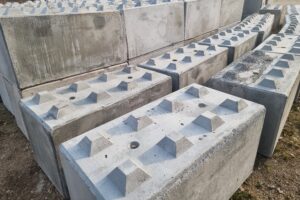
Temporary fencing is one of the first things to go up on a construction site and one of the last to come down. It marks the boundary, keeps the public away from hazards and helps protect plant and materials. But a fence only does its job while it is standing. Choosing the right concrete temporary fence feet, and installing them properly, is a simple way to reduce the chance of panels blowing over when Queensland’s summer storms arrive.
In this guide we cover why fence stability matters, what the current Australian Standard says, how wind and shade cloth change the picture, and what to look for when you order feet for your next project.
Why Temporary Fence Stability Matters on Queensland Sites
Under section 298 of Queensland’s Work Health and Safety Regulation 2011, a person conducting a business or undertaking (PCBU) at a workplace where construction work is carried out must manage the risks of unauthorised access to the site. WorkSafe Queensland notes that temporary fencing is one of several ways to do this, and that the right level of security depends on a risk assessment.
That assessment should consider things like:
- The health and safety risks to people who enter the site without permission
- How likely unauthorised access is, for example if the site is near a school, park or shopping centre
- How hazards on site can be isolated if access cannot be fully prevented
A fence that has blown over or been left with gaps no longer controls those risks. Fallen panels can also become a hazard in their own right for footpaths, roads and neighbouring properties.
What AS 4687 Says About Temporary Fencing
Temporary fencing in Australia is covered by the AS 4687 series, which was updated in 2022. The series is split into four parts:
- AS 4687.1: General requirements, including design actions such as wind
- AS 4687.2: Temporary fencing and temporary pedestrian barriers
- AS 4687.3: Temporary hoardings
- AS 4687.4: Temporary swimming pool fencing
One of the most important changes was clearer guidance on wind. The earlier 2007 version was widely regarded as ambiguous on design wind speed. The 2022 update sets a gust wind speed of 39 m/s (about 140 km/h) for conventional construction sites. The South Australian Department for Infrastructure and Transport has pointed out that the older design figure of 15 m/s (54 km/h) is commonly exceeded across Australia, which shows how much expectations have shifted.
The standard also includes testing to check that a fence does not overturn in wind, along with climbing and impact tests. If you are unsure which fence class or configuration suits your site, check with your fencing supplier and, where needed, a design engineer.
How Wind, Shade Cloth and Signage Affect Your Fence
A bare mesh panel lets most of the wind pass through. Once you add shade cloth, banner mesh, signage or acoustic screening, the panel starts to behave more like a sail. Government safety guidance notes that these coverings increase the wind load on the fence and can knock it off balance even when the feet are holding it down.
That is why bracing matters as much as the feet themselves. Points to keep in mind:
- Add bracing whenever the fence is covered: Shade cloth and signage should always be paired with extra stays and bracing.
- Pay attention to gateways and end panels: These are the weakest points in a fence line and need additional bracing.
- Check the fence is plumb: Guidance based on the standard notes that fencing should be installed no more than 3 degrees out of plumb before additional braces are needed.
- Plan for the whole project: The longer fencing stays in place, the greater the chance it will face a high-wind event. A fence installed in winter may still be standing through storm season.
Wind loads depend on the site’s location, exposure and the fence configuration, so the bracing layout for a covered or exposed fence should be confirmed by a competent person or engineer.
Choosing Concrete Temporary Fence Feet
Fence feet are the base that holds each panel upright and connects it to the next. Concrete temporary fence feet are a popular choice on civil and commercial sites because they provide a heavy, low-profile base that sits on the ground without needing to be dug in or fixed.
Our Temporary Fence Feet are manufactured locally and made to order. Each foot measures 580 x 250 x 180 mm and weighs approximately 33 kg. You can see the rest of our range on our Our Products page.
When ordering feet for a project, think about:
- Fence length and layout: Count panels, gates, corners and end points so you order enough feet, plus spares for changes in the fence line.
- Weight for bracing: Stays and braces also need to be held down, so allow for extra feet or ballast at braced points.
- Ground conditions: Feet should sit on firm, reasonably level ground. Soft, sloping or waterlogged ground can let feet sink or tilt, which pulls the fence out of plumb.
- Handling and delivery: Large quantities are easiest to handle when delivered on pallets close to where they will be installed. Our crane truck is also available for hire on larger jobs.
- Re-use: Concrete feet are durable and can be moved and re-used across project stages or on future sites.
Installation and Inspection Tips for Storm Season
Good installation turns quality components into a stable fence. Before and during the wet season, we recommend:
- Inspect the fence line regularly: Always check after strong winds or heavy rain. Look for leaning panels, missing clamps, feet that have shifted and gaps at gates.
- Keep the perimeter clear: Overgrown vegetation and stacked materials against the fence can add load or create climbing points.
- Secure every joint: Clamps should be fitted at each panel connection so the fence acts as one continuous line.
- Watch for washouts: Heavy rain can erode the ground under feet, especially on slopes. Our guide to preparing construction sites before Queensland’s summer wet season covers drainage and ground protection in more detail.
- Review coverings before severe weather: Remove or reduce shade cloth and banners if the fence has not been designed and braced to carry them.
A Note on Temporary Pool Fencing
If your project involves a swimming pool in Queensland, temporary pool fencing has its own rules. The Queensland Building and Construction Commission states that a temporary pool fence can be used for up to 3 months, provided it has been inspected and approved by a building certifier or pool safety inspector. Beyond that period it must be re-inspected and written permission obtained to keep using it. Speak with your certifier before relying on temporary fencing around a pool.
Frequently Asked Questions
How heavy are InfraBlock’s concrete temporary fence feet?
Each foot weighs approximately 33 kg and measures 580 x 250 x 180 mm. They are made to order, so contact us early to line up supply with your project start date.
Do I need extra bracing if my fence has shade cloth or signage?
Yes. Safety guidance is clear that coverings increase wind load and can overturn a fence even when the feet are holding it down. Covered sections, gates and end panels should have additional stays and bracing, and an engineer should confirm the layout on exposed sites.
Is temporary fencing mandatory on Queensland construction sites?
Not in every case. Queensland’s WHS Regulation requires the PCBU to manage the risk of unauthorised access, and WorkSafe Queensland describes temporary fencing as one of several ways to do that. The right approach depends on your site’s risk assessment.
Talk to InfraBlock About Your Next Project
Whether you are fencing a small residential build or a long civil corridor, we can help you work out how many feet you need and arrange delivery to your site.
Contact InfraBlock today for an obligation-free quote. Call 0478 102 201 or email info@infrablock.com.au.