Most retaining wall failures on the Gold Coast don’t start at the face of the wall — they start behind it. Water that has nowhere to go builds pressure in the soil, adds load the wall was never designed to carry, and eventually makes itself known through cracking, movement, or collapse. This post covers how retaining wall drainage systems work, what every component does, and what Queensland conditions demand of the design before a single block goes in.
Why Drainage Is the Most Critical Factor in Retaining Wall Performance
A retaining wall holds back soil, but what it’s really managing is the combined force of soil weight and water pressure. When rain saturates the ground behind a wall, the soil becomes heavier, more mobile, and begins to push outward in ways a well-drained wall would never experience. Hydrostatic pressure is consistently the leading cause of retaining wall failure in South-East Queensland, ahead of poor material choice or construction errors.
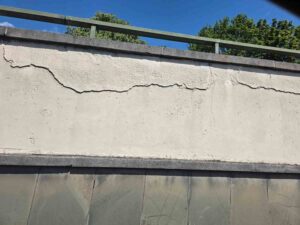
The consequences follow a predictable pattern: horizontal cracking and slight forward lean at the base appear first, then base cracking widens, the wall face rotates outward, and structural failure follows. It is one of the most preventable failure modes in retaining wall construction, and it starts with getting the retaining wall design mistakes right before a single block goes in.
The Core Components of a Retaining Wall Drainage System
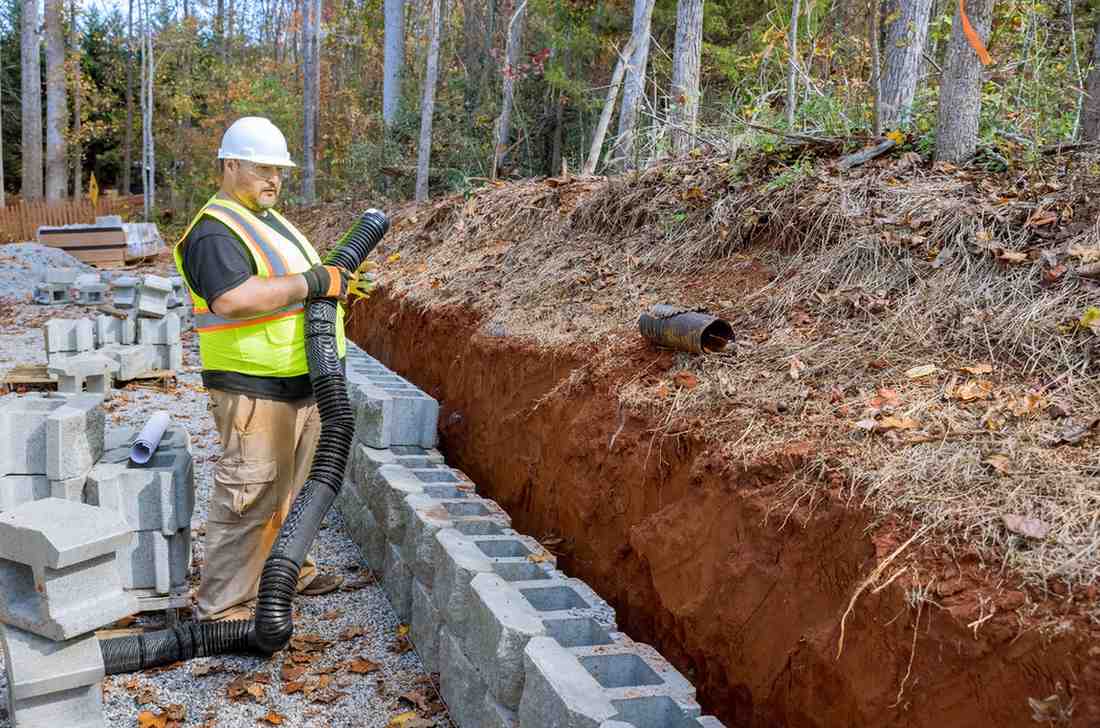
Drainage behind a retaining wall isn’t a single product — it’s a system of interdependent components that must be specified together, installed in the correct sequence, and checked before backfilling closes access to them. Remove or compromise any one part and performance degrades, often invisibly, until water pressure has already done structural damage.
The key components are:
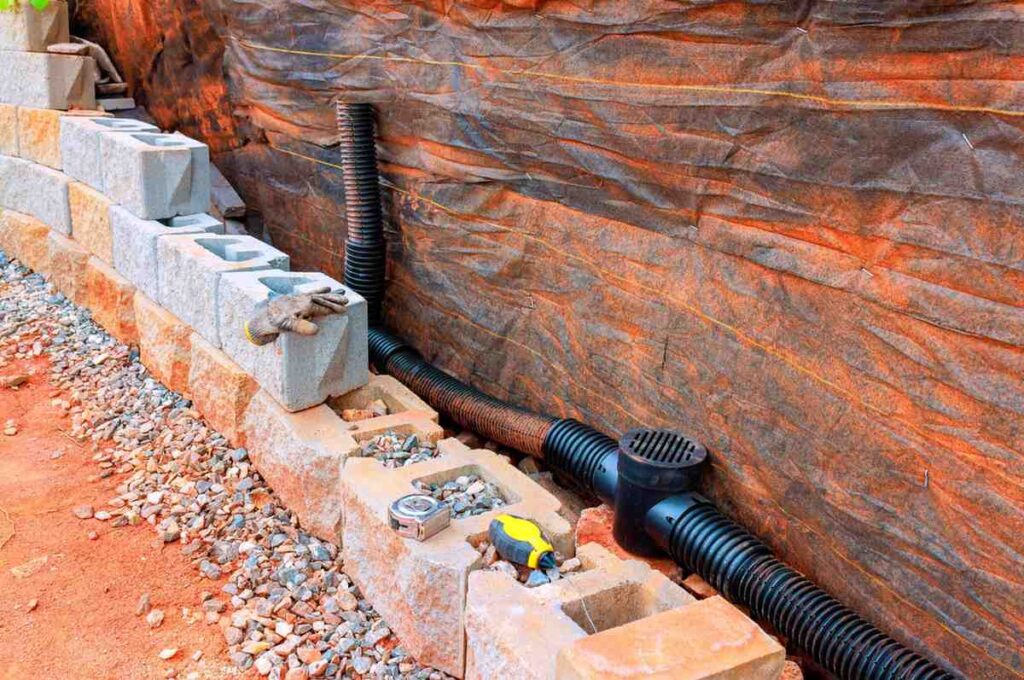
- Aggregate backfill: Coarse gravel placed directly behind the wall allows water to move freely downward toward the drainage pipe. Fine or mixed materials compact over time and progressively block the drainage path
- Geotextile filter fabric: A permeable fabric layer separating gravel backfill from native soil. Without it, fine soil particles migrate into the drainage layer under hydraulic pressure, gradually clogging the aggregate over time
- Weep holes: Openings at regular intervals along the wall base that allow water to exit to the front face. Undersized or poorly spaced weep holes restrict flow precisely when the system is under the most demand
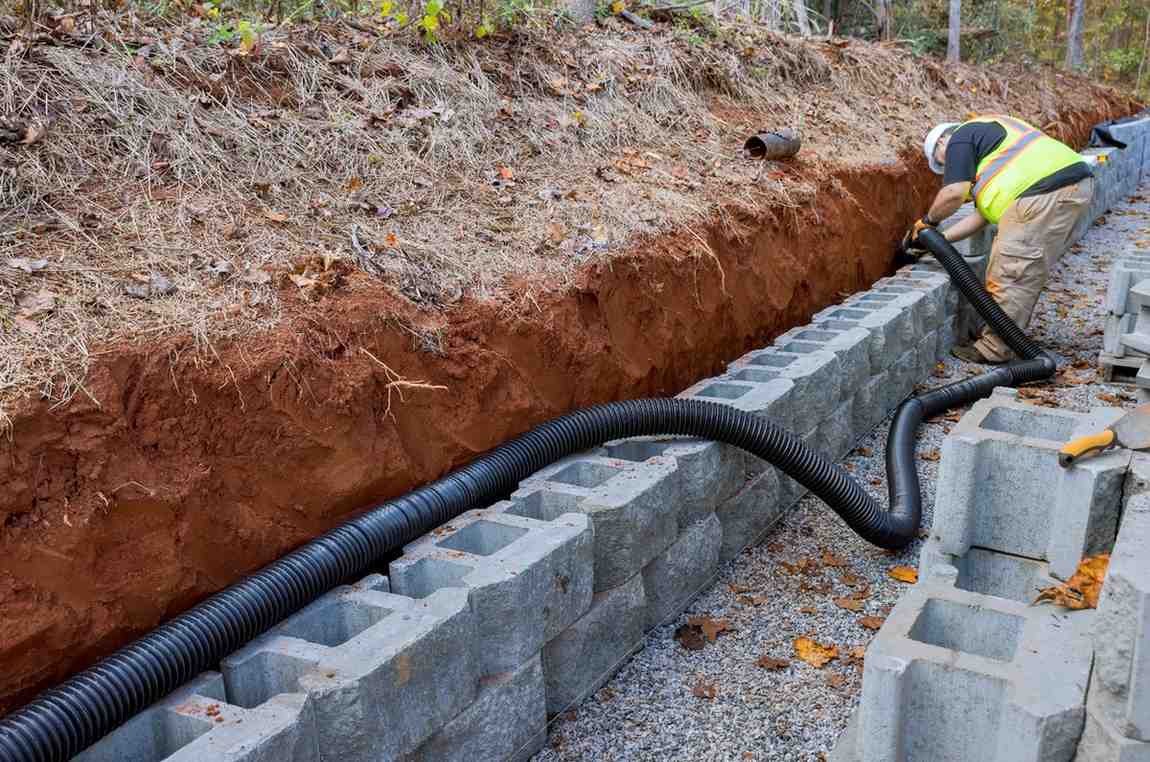
- Perforated drainage pipe (ag pipe): Installed at the base of the backfill zone to collect water and channel it to a discharge point. The pipe must be laid with a consistent fall, as flat ag pipe creates standing water at wall base level rather than moving it out
- Compacted base: Supports the drainage pipe in position, provides a stable wall footing, and prevents settlement that would redirect water or compromise pipe fall after construction
The system logic runs in one direction: water moves from native soil through the geotextile, into the aggregate, down to the ag pipe, and out through the discharge point or weep holes. Any break in that sequence creates a point where water accumulates rather than drains.
Choosing the Right Drainage System for Your Retaining Wall
Not every retaining wall site calls for the same drainage approach. The right system depends on wall height, soil type, site topography, and the volume of water the wall is expected to manage. Understanding the options helps builders specify correctly at the design stage rather than defaulting to a single solution regardless of site conditions.
The most common drainage systems used behind retaining walls on Gold Coast sites are:
- Ag pipe and aggregate system: A perforated pipe at the base of a gravel backfill zone collects and channels water to a discharge point. Suitable for the majority of residential and commercial retaining wall builds across South-East Queensland
- Blanket drain: A continuous aggregate layer running the full height of the retained zone, used where water volume is high or soil permeability is very low — particularly relevant on Gold Coast clay sites with significant retained height
- French drain: A gravel-filled trench with perforated pipe, installed at the base of the wall or upslope to intercept groundwater before it reaches the retained zone. Most useful where subsurface water movement toward the wall is a known site condition
- Surface drainage channels: Intercept stormwater runoff at the top of the retained zone before it enters the backfill. Used in combination with a subsurface system where hardstand or paved areas sit directly behind the wall
For most Gold Coast retaining wall projects, an ag pipe and aggregate system with geotextile fabric is the correct specification. Blanket drains and French drains become relevant on higher-risk sites — steeper slopes, heavier clay profiles, or walls with significant retained height. On complex sites, the engineer’s brief will specify the combination required.
How Queensland Conditions Affect Drainage Design
Much of South-East Queensland sits on clay and clay-loam soils that hold water rather than releasing it. When those soils become saturated, lateral pressure behind a retaining wall increases sharply, and unlike sandy soils, clay pressure takes longer to build and longer to dissipate.
Retaining wall drainage in Queensland needs to be designed for worst-case volume, not average conditions. Drainage layer depth, ag pipe diameter, and discharge capacity all need to account for what the site experiences in January, not what it looks like in June. Winter is the preferred build window across South-East Queensland because lower ground saturation makes construction more predictable, but the system installed in June needs to perform through summer.
Common Drainage Mistakes That Lead to Wall Failure
Most drainage failures are foreseeable. The decisions that cause walls to move or fail are made during design and installation, and they become invisible once the wall is built and backfilled. By the time the consequences appear, remediation costs multiples of what correct installation would have added.
| Common Mistake | What Goes Wrong |
| Fine soil or mixed fill used as backfill | Compacts under load and blocks drainage flow entirely within a few seasons, leaving the wall with no functional drainage zone |
| Geotextile fabric omitted | Native soil migrates into aggregate over time; drainage capacity degrades invisibly until the system fails under load |
| Weep holes missing or incorrectly spaced | Pressure builds with no relief path; the wall face takes full hydrostatic load, accelerating base cracking and forward movement |
| Ag pipe installed without fall to discharge | Water pools at low points rather than exiting; the footing zone sits in standing water, weakening the base and increasing pressure |
| Existing site drainage not investigated | New wall construction inadvertently blocks established drainage paths, concentrating water that previously dispersed across the site |
Drainage solutions for retaining walls need to be designed before the wall goes up. Not treated as an installation detail to be resolved on site. InfraBlock’s precast blocks are manufactured to consistent tolerances, which means the geometry of the drainage zone behind the wall stays as designed from base course to top.
Drainage Considerations for Concrete Retaining Walls Specifically
Precast concrete blocks are non-porous, so the entire drainage load falls on the backfill system rather than the wall material itself. This is a structural advantage — the wall won’t degrade from moisture ingress or lose integrity from prolonged ground contact. But it makes correct drainage installation non-negotiable.
On a concrete retaining wall, there is no passive moisture relief through the wall face. Every drop of water that needs to exit the retained zone must move through the aggregate, through the weep holes or ag pipe, and out to the discharge point. If any part of that path is blocked, pressure builds with nowhere to go.
This is particularly relevant on Gold Coast sites where drainage for concrete retaining walls must account for both wet season rainfall volume and clay soils that slow natural ground absorption. On flood-prone sites, the design needs to factor in sustained inundation, not just episodic rainfall events.
What Gold Coast Council Requires for Retaining Wall Drainage
In Queensland, retaining walls over one metre in height typically require engineering certification and council approval, and drainage design is a standard component of that documentation. Gold Coast City Council and other South-East Queensland councils expect evidence that water management behind retaining walls has been addressed in the approved design.
For certain site conditions, drainage requirements within the engineering brief become more detailed:
- Walls near property boundaries: discharge location and containment requirements apply to prevent directing water onto adjacent properties
- Walls adjacent to existing structures: the engineer’s brief will typically specify drainage layer depth, geotextile specification, and discharge point as part of the certified package
- Walls on sloped sites: drainage design must account for gravity-driven water movement, with discharge routing confirmed before construction begins
Confirm specific requirements with your certifying engineer and Gold Coast City Council early in your planning, as requirements vary by site classification, wall height, and proximity to boundaries or structures. For builders specifying materials on compliant retaining wall projects across the Gold Coast, InfraBlock manufactures and supplies precast concrete blocks engineered to AS4678, providing the structural consistency that certified drainage designs depend on.
Frequently Asked Questions
How deep should the drainage aggregate layer be behind a retaining wall?
As a general guide, the aggregate drainage layer should be at least 300mm wide for the full retained height. The exact specification depends on wall height, soil type, and the engineer’s design — taller walls and clay-heavy soils typically require a more substantial drainage zone.
Do all retaining walls need weep holes?
Most retaining walls benefit from weep holes, and for engineered walls in Queensland they are generally required as part of the approved drainage design. Any wall over 600mm in clay-prone areas of the Gold Coast should include them as a minimum.
What is the best backfill material for retaining wall drainage?
Clean coarse aggregate — typically crushed rock or gravel in a 10–20mm grade — is the preferred material. Fine materials, recycled mixed fill, or compacted soil are not suitable and will progressively reduce system performance under load and wet-dry cycling.
How does hydrostatic pressure cause retaining walls to fail?
Water accumulating behind a wall with no escape path exerts lateral pressure against the wall face on top of the load already carried from soil weight. Once combined force exceeds design capacity, the wall moves, cracks at the base, or rotates forward. Correct drainage eliminates the water accumulation that drives this process.
Does Gold Coast council require drainage for retaining walls?
Yes. For walls requiring engineering certification — generally those over one metre — drainage provision is a standard component of the approved design documentation. Confirm specifics with your certifying engineer and Gold Coast City Council at the planning stage.
Why Choose InfraBlock for Your Retaining Wall Project on the Gold Coast
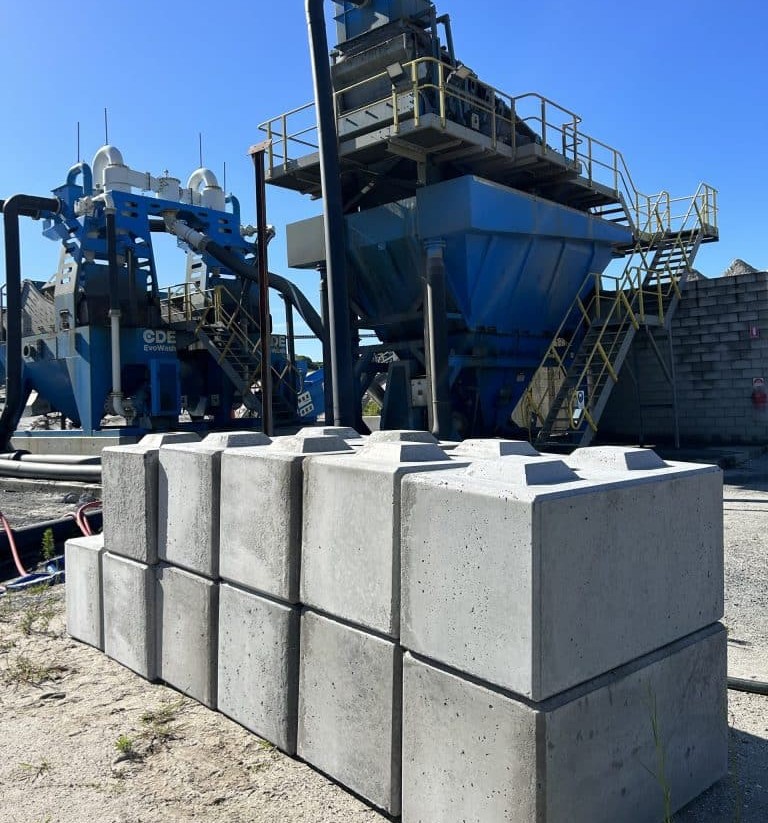
InfraBlock is a Gold Coast-based manufacturer and supplier of precast concrete blocks, producing retaining wall systems to AS4678. Every block leaves the factory to consistent dimensional tolerances. When wall geometry is predictable, the drainage layer behind it can be installed as designed rather than adjusted on site.
Our Large Interlocking Block delivers the mass and structural rigidity required for high-load retaining applications across residential, commercial, and civil projects, while our Smooth Large Interlocking Block provides a clean finished face where appearance alongside drainage performance is a priority. Both products are manufactured to AS4678, giving builders and engineers the certified documentation Queensland councils require.
Get Your Retaining Wall Drainage Right From the Start
A drainage system that works isn’t complicated, but it does need to be specified correctly, installed in the right sequence, and built with materials manufactured to a consistent standard. InfraBlock supplies precast concrete retaining wall blocks to builders, developers, and civil contractors across the Gold Coast and South-East Queensland, with reliable lead times and product specifications that support compliant, engineered designs.
Speak to our team about your retaining wall project before the next wet season arrives. Call 0478 102 201 or email info@infrablock.com.au, and we’ll help you get the right products specified for your build.